李欣蔚,来自李淑宇老师课题组,学号BY1110106,系我院生物医学工程专业2011级博士研究生。于2015年3月30日在期刊《Psychiatry Research: Neuroimaging》上发表题为《Abnormalities of structural covariance networks in drug-naïve boys with attention deficit hyperactivity disorder》高水平学术论文一篇,该期刊影响因子为2.831。
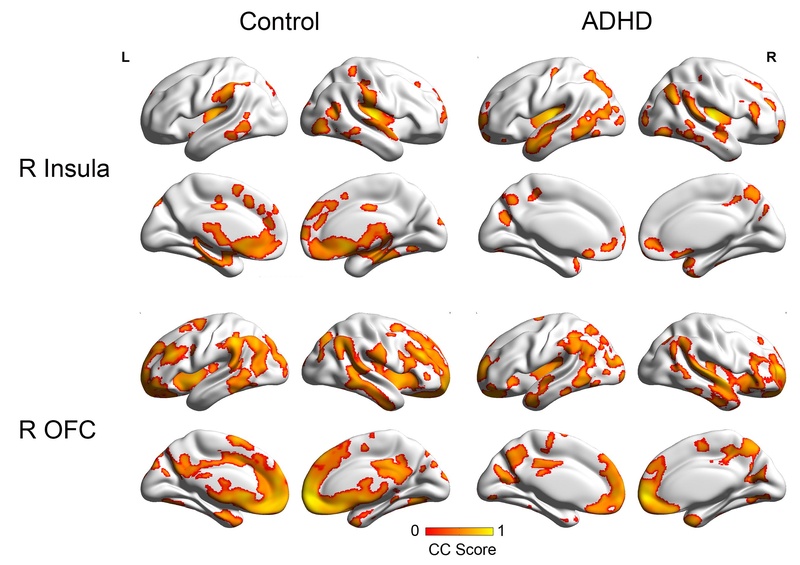
ADHD是儿童中最常见的一种神经发育疾病。本文旨在研究ADHD病人是否存在大尺度大脑系统解剖构成的改变。文中采取基于体素的形态学对大脑结构网络进行研究,检测大脑皮质不同区域灰质体积的共变模式。研究结果发现ADHD病人右侧的岛叶及眶额叶皮层发生显著性的灰质体积减少,以这两个区域为种子点获取的大脑结构网络都表现出了收缩的拓扑结构。本研究揭示了ADHD病人存在异常的局部大脑结构及大尺度大脑结构网络。
Abnormalities of structural covariance networks in drug-naïve boys with attention deficit hyperactivity disorder
Xinwei Lia,b,1,Qingjiu Caoc,d,e,1, Fang Pua,b, Deyu Lia,b, Yubo Fana,b, Li Anc,d,e, Peng Wangc,d,e, Zhaomin Wuc,d,e, Li Sunc,d,e, Shuyu Lia,b*, Yufeng Wangc,d,e*
aKey Laboratory for Biomechanics and Mechanobiology of the Ministry of Education, Beihang University, Beijing 100191, China
bSchool of Biological Science & Medical Engineering, Beihang University, Beijing 100191, China
cPeking University Sixth Hospital, Beijing 100191, China
dInstitute of Mental Health, Peking University, Beijing 100191, China
eKey Laboratory of Mental Health, Ministry of Health, Peking University, Beijing 100191, China
Abstract
The aim of this study is to investigate whether the anatomical organization of large-scale brain systems would change in ADHD patients compared to healthy controls. We utilized a structural covariance network (SCN) mapping approach to investigate large-scale networks in 30 drug-naïve ADHD boys and 30 gender- and age-matched controls. The regions showing significant between-group differences in gray matter (GM) volume were defined as seed regions of interest. Then, the SCNs derived from these seeds were statistically compared between ADHD and controls. Significant regional GM volume decreases (P<0.05, corrected) were observed in the right insula and the right orbito-frontal cortex (OFC) in ADHD relative to controls. Both SCNs derived from these two seeds showed more localized topology in ADHD group. Furthermore, significantly decreased structural connectivity were found between insula and right hippocampus, bilateral olfactory cortex, and between OFC and bilateral caudate nucleus (P<0.05, corrected) in ADHD group. Significantly increased association was observed between insula and left middle temporal gyrus (P<0.05, corrected) in ADHD group. Taken together, our results reveal abnormal regional brain anatomy as well as aberrant structural covariance networks in ADHD, supporting previous findings of dysfunction in distributed network organization in patients with ADHD.
Keywords: ADHD, SCN, orbito-frontal cortex, insula
 搜索
 导航